



Creativity and innovation is the key to export prosperity, as these Australian Export Awards finalists and winners demonstrate. Dynamic Export asks about their export experience to date.
Global EARS Limited
Think pneumatic drills and you think pounding noise; Global EARS flagship product, the Exhausted Air Recycling System (where the ‘EARS’ came from), takes the volume down to just 67 decibels, less than an average household vacuum cleaner.
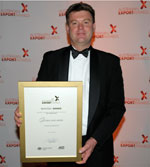
When inventor Chris Bosua tried to make a pneumatic manufacturing machine work with an air compressor too small for the job, he noticed that a lot of energy was going to waste through the pneumatic exhaust. With a background in mechanical engineering, Bosua developed a closed loop system that sent the air back to the compressor, similar to a hydraulic tool. His innovation doubled the capacity of an ordinary compressor and dramatically reduced the noise created during operation.
Size: 5 staff
Turnover: $1.8 million
Years in operation: 3
Main export markets: Europe (Germany, Sweden, UK) and USA
Why do you think your business has been so successful?
Largely because the product EARS is the most substantial advance in the compressed air industry, in terms of efficiency and safety, in the last 30 years. Air compressors have been around for over 100 years, and yet a standard screw compressor is only about 15 percent efficient. In practice, many compressors are running at under 10 percent efficiency due to poor selection and lack of maintenance of the complete air system.
Chris Bosua, our CEO and inventor, has a background as a motor mechanic and running his own business from the age of 19, importing motors and gearboxes and adapting those to Australian conditions. While motor vehicle engines now involve a lot of electronics, air compressors are mostly mechanical and Chris has been able to adapt his knowledge very creatively into this industry.
What was the biggest export risk you took?
We decided to go global from day one and organised meetings and installed EARS into the R&D (research and development) departments of two international companies for testing. However, their decision-making was slow and they were not really interested. We then decided to tackle the retro-fit market by going directly to end users, which involved introducing a new product into new markets. This meant outsourcing manufacturing, marketing and distribution so that we could operate with a small team and grow quickly.
The risk is that when you are small and you start out, you don’t attract the big players, and when you do, they often want to control the process. If you grow quickly with a small company, you can find that they may not be able to fund your growth or they cannot focus sufficiently on your business. However, during 2006 to 2008 we sold the licence for the EARS patent into 12 countries and entered into a joint venture partnership in a further 15 countries.
What was the biggest disaster?
Not a disaster, but the hardest thing to overcome was the resistance to new technology and the difficulty in finding distributors who could both install and sell compressors into the retro-fit market, as the main existing distributors are attached to the five major global manufacturers. Installers tend to be technically strong, but undercapitalised and not marketers, while normal distributors tend to be good marketers, but don’t have the technical knowledge to do installations.
What was the greatest highlight?
The main challenge in 2008 was to tackle the German market by working with the licensee for Germany and committing to help them find and train 30 distributors. Our main market is in screw compressors where the global market is dominated by five manufacturers operating out of Germany, Sweden, USA and UK. However, the R&D on screw compressors is mainly performed in Germany, even by the USA & UK companies.
The challenge was to convince German distributors the benefits of EARS while working through a German translator. At one stage we had to change over our test equipment after one engineer claimed the results could not be that good and that the test equipment must be faulty.
By November 2008, our licensee had appointed 25 distributors and produced a 114-page full colour catalogue in German covering all the EARS products and technical support for distributors. We also attended the Automechanika and Motek trade shows in German and received over 300 enquiries for our distributors.
What do you think can be done to make the export process easier?
The EMDG [Export Market Development Grants scheme] needs to be fully funded. In 2007/08 we spent $315,000 ($150,000 claimable grant) on export expenses but only got $40,000 back in August 2008, and an unknown amount will be paid in June 2009. It is difficult to plan for marketing activities if you are unsure when and how much you will receive.
What was the best money you have ever spent?
Money spent on airfares and accommodation to attend international trade shows was our best investment. We were able to use leverage to get either suppliers or customers (licensees) to pay for the cost of the trade shows. This has enabled us to present EARS at 17 trade shows in the last 18 months. The cost of major trade shows in Germany and the USA are restrictive for many new businesses.
What do you wish you had known when you started?
That a share market downturn and world recession would commence in October 2008, just when we were about to issue a share offer to raise money to grow the business.
What are your intentions for the future?
In November 2008 we changed our strategy due to the global uncertainty and decided to increase our export expenditure and concentrate on the highest potential overseas markets, but also to substantially increase our R&D on three new products. We currently have government funding to produce a new compressor, which we expect to improve the efficiency over a standard compressor by 130 percent.
We have also designed another new compressor using different technology, which will be available on the market in 2011, achieving even higher efficiency gains, with the prototype results being available by mid 2009. We are offering 20,000,000 preference shares at six cents per share to fund this growth, which we expect to be taken up as we release the R&D results on the three products during 2009.
Our goal is to be the global leader in carbon reduction technology in the compressed air industry by 2011 by achieving electricity savings of over 60 percent compared to the current performance of a standard screw compressor. Compressed air systems use up to 10 percent of total industrial electricity use in Australia; with 73 percent of the cost of a compressor due to energy use, significant cost savings will be made by improving efficiency.
—Robert McInnes, finance and commercial director for Global EARS
* Global EARS won the Small Business Award category at the 2008 Australian Export Awards
Haltech Engine Management Systems
What started as a quest to develop diagnostic equipment for electronic fuel injection ended up as a different commission altogether when Modern Motor magazine asked Haltech founder Steve Mitchell to find a way to fuel a supercharged Ford project car. The result was a supplementary fuel injection computer, which was then followed by a turbo timer. It was only a step to the development of the world’s first real time, PC programmable engine management system, which could be used while the engine ran.
Today, the company provides engine management solutions for use in cars, motorcycles, off-road vehicles, boats, jet skis, outboards, snowmobiles, karts, motor homes and aircraft, controlling throttle body, multi-point or staged injection, distributor or direct ignition, naturally aspirated or turbo or supercharged engines.
Size: 22 staff
Turnover: $4 million
Years in operation: 22
Main export markets: Europe, Iran, Thailand, USA
Why do you think your business has been so successful overseas?
Australian products are widely recognised as good quality products at a reasonable price. Haltech’s products are well engineered and easy to use; this is essential for export growth.
What was the biggest export risk you took?
Setting up a satellite office in the USA was a big, expensive step for us, finding locals who you can trust, and who can also fulfil the many and varied roles in running a small technical business, is a challenge.
What was the biggest disaster?
Trusting the workmanship of other cultures. One example was a trade show we were attending in Iran. Our display stand needed some basic construction to be erected correctly. Finding a drill and drill bits took the most part of a day, but once the parts were found there was a random power outage so we had to wait another three hours before we could drill three holes in a backing board. Now we take all our own cordless tools for construction.
What was the greatest highlight?
Winning at the NSW Export Awards [in the Small Business Award category] was a real buzz this year. To be recognised and rewarded for our export achievements, and to have the additional exposure that comes with that, has been a great highlight for Haltech.
What do you think can be done to make the export process easier?
A significant area of opportunity is in low volume shipping; although we export a lot of products, what we do export is small in size and delivered by couriers such as FedEx and DHL. The documentation and information process for duties inbound and outbound can be very frustrating and time consuming, having products caught in customs for weeks on end waiting on HS clarification can be a real problem.
What was the best money you have spent?
The best investment we have made for our export sales, and domestic sales for that matter, has been to invest in our own production machines. Not having to rely on someone else for any area of production allows for much faster turnaround times and reduced development costs.
What do you wish you had known when you started?
How much government help was available. It took us a lot of years to start to utilise government help such as Austrade and EFIC, and now we don’t know where we would be without them.
What are your intentions for the future?
Continue to expand our product range by diversifying our market share from just aftermarket products into an OEM supplier to some of the world’s smaller automobile manufacturers. From there, who knows? Continue to open the door when opportunity knocks, which it always does.
—Matt Wright, international project manager at Haltech
Recruitment Systems
Customer relationship management (CRM) can be a complicated task when it comes to handling streams of data on hundreds of job candidates. Recruitment Systems is a Canberra-based software company that solves this problem with a product that assists recruiters with managing their client relationships and interactions with job candidates by automating common administrative tasks such as data entry and job application screening.
The first system was a database for handling everything from temporary staffing to executive search across multiple industry sectors, but this has since evolved into a full-function recruitment CRM. The result is technology that combines business strategy with the role of human resources, facilitating the personal and professional development of recruiters.
Size: 19 staff in Canberra, Sydney and Russia
Turnover: $2.2 million
Years in operation: 7
Main export markets: 20 countries including Canada, China, Singapore, the United Arab Emirates and the United Kingdom
Why do you think your business has been so successful overseas?
Like many software businesses, Recruitment Systems was born global. As soon as we had finished testing the system in Canberra, we started marketing our database product over the internet. Our solutions quickly became popular overseas because we developed a deep knowledge of the needs and challenges of our clients. We sell software specifically for recruitment agencies and, with former recruiters in our team, we were able to design the most intuitive solution for this industry.
What was the biggest export risk you took?
The biggest perceived risk was our recent expansion into Mainland China. With copyright infringement rampant and the aptitude of Chinese developers to quickly reverse engineer software, there were some real fears about this market entry. We now have users of our flagship solution, the TRIS Recruitment CRM, in Shanghai and Beijing and have become confident that our experience and sophisticated technology will be impossible to copy.
What was the biggest disaster?
A very challenging decision we chose to make created a short-term financial crisis. Instead of charging our clients a one-off fee for our software, we decided to offer subscription pricing. This immediately restricted cash flow to a trickle. After a few months of recurring revenue, we realised we had made the right decision and today our revenue streams are much more sustainable.
What was the greatest highlight?
The greatest highlight was our recent Export Award win [in the Small Business Award category at the ACT Export Awards]. Although we have been exporting successfully for over half a decade, it was great to be recognised with this accolade. Hopefully we will soon qualify for the SME award as we continue to expand.
What do you think can be done to make the export process easier?
Advice, support and introductions from Austrade make it so much easier to export successfully. We do not enter a new market without first talking to Austrade. Trade advisers from Austrade in China, the Middle East and across the Pacific quickly put us in touch with very high profile contacts and helped us easily understand the intricacies of markets abroad.
What was the best money you have spent?
We always believe in working with the best corporate consultants, no matter what the cost. The money we have spent on corporate strategy advisers has been an excellent investment with very healthy returns. The big consulting firms can seem overpriced, but the revenue generating potential of this advice completely justifies the cost.
What do you wish you had known when you started?
It would have been great to understand the importance of follow up. Too many ideas have lost traction and hundreds of leads have gone cold due to our lack of follow up. We now have excellent systems to help us always follow up opportunities including TRIS, our customer relationship management system.
What are your intentions for the future?
We will continue to expand our market share in Australia but also enter new markets in the Middle East and North Africa region. At the 2008 GITEX trade show in Dubai we witnessed overwhelming demand, and with the current financial crisis really hitting our local clients hard, we have been able to focus on some excellent opportunities abroad.
—Neil Bolton, CEO, and Mark Tayar, marketing manager, at Recruitment Systems
Ta Ann Tasmania
A partnership between Forestry Tasmania and Malaysian-based timber company, the Ta Ann Group, resulted in a multimillion dollar development at two sites in the state to turn regrowth logs into a successful export product: wood veneer.
The rotary veneer peeling mills, at Huon and Smithton in Tasmania, turn short logs that cannot be used for saw milling into useable products. Regrowth logs previously classified as pulpwood can now be peeled to create construction grade products instead of being chipped, an innovative concept that has added value to, and found new markets for, Tasmanian eucalypt wood.
Size: more than 130 staff at full production
Turnover: $50 million
Years in operation: 1
Main export markets: Veneer mainly exported to Malaysia for manufacturing into flooring ply or construction ply (Japanese market), and to China for container flooring
Why do you think your business has been so successful overseas?
Due to research and development of a speciality floor product for a niche market, EcoOak Ply, which is100 percent eucalypt plywood from certified sustainable regrowth and plantation resource using the world’s best equipment.
What was the biggest export risk you took?
Capital expenditure of $70 million on an untested venture in Tasmania.
What was the biggest disaster?
Nil.
What was the greatest highlight?
Production of the first veneer at Huon (southern Tasmania) and Smithton (northwest Tasmania) in the new rotary peel veneer mills.
What do you think can be done to make the export process easier?
Additional resources for each mill on a sustainable basis so that monthly single port shipments can occur, rather than two port shipments from Burnie and Hobart.
What was the best money you have spent?
The $70 million on the two new mills and associated equipment from Japan (lathes and dryers), Germany (dryer), Finland (wrapper), Korea (log cutting line), Malaysia (boiler) and Tasmania (pulling it together).
What do you wish you had known when you started?
The world price of oil and associated shipping rates.
What are your intentions for the future?
To prove the current business and then invest in additional value adding in Tasmania.
—David Ridley, resource and community relations for Ta Ann
* Ta Ann won the Emerging Exporter Award category at the 2008 Australian Export Awards
Urban Art Projects
Think ‘street art’ and you might have a mural in mind; Urban Art Projects (UAP) turns this around with their dynamic, tailor-made approach to producing site-specific artwork and custom street furniture for architectural and landscape environments.
UAP manages the artwork process from concept stage through to the documentation and construction phase, sourcing artists and providing services from their own foundry, which specialises in bronze and aluminium metalwork, timber and mosaic.
The company won the 2008 Queensland Emerging Exporter Award category.
Size: 81 staff
Turnover: $9.5 million (07/08), $27.5 million (08/09 forecast)
Years in operation: 16
Main export markets: China, North America and the Middle East
Why do you think your business has been so successful overseas?
Our business operates in a niche market and we focused our attention on key clients and projects, dedicating business development funding on face-to-face meetings rather than big expenditure on advertising.
What was the biggest export risk you took?
Our first big risk was to dedicate all our available cash flow from our Australian business on developing the offshore market. The next: upscaling our business by way of personnel, premises and additional resources to ensure our business was suitably geared to deliver our pending, but unconfirmed at the time, offshore contracts.
What was the biggest disaster?
We have not yet had a big disaster; maybe it was not investing sooner in export – we lost a few good years.
What was the greatest highlight?
Securing our first major international contract with HOK in Atlanta thanks to Monte Wilson and Todd Arnold, and of course securing the design of the major entry points to the Shanghai World Expo 2010.
What do you think can be done to make the export process easier?
Export can be very rewarding—personally, culturally and, of course, financially—but easy it is not. You will require commitment, stamina and tenacity; imagine starting your business from scratch but in another country, culture and language. Develop strong communication lines with Austrade, State Government agencies and other exporters to help avoid the pitfalls.
What was the best money you have spent?
Appointing local business development managers in our export markets: they are culturally sensitive, understand the local market conditions, and cut through the distractions and make business happen.
What do you wish you had known when you started?
It gets easier. When we first started we were staying in grungy three-star hotels, trying to establish meetings with half-interested clients and trying to stay upbeat.
What are your intentions for the future?
We have a strong desire to continue to grow our business, stay creative, nimble and deliver great projects worldwide… and still call Australia home.
—Daniel Tobin, principal of Urban Art Projects
